If part of your job is booking accommodation for other people — a visiting executive, a consulting team in for a three-month engagement, a colleague relocating with their family — you already know that Dublin is one of the more difficult cities to get right. Hotel rates spike without warning around conferences and rugby internationals, the genuinely good serviced apartments are held by a small number of operators and book out early, and the difference between the right postcode and the wrong one is the difference between a guest who settles in quietly and one who emails you on day three asking to be moved.
This guide is written for the person doing the booking — the EA, the HR or mobility lead, the office manager, the relocation coordinator, or the executive sorting their own stay. It covers the decisions that actually matter: which neighbourhoods suit which kind of stay, what to budget, when a serviced apartment beats a hotel (and when it doesn't), and how to lock in the right place before your guest lands. Everything here reflects how we work as a Dublin serviced apartment operator hosting corporate guests across sixteen apartments in the city.
First question: is a serviced apartment actually the right format?
For a one- or two-night trip, a hotel is usually the simpler choice. The serviced apartment comes into its own the moment a stay passes roughly a week, and becomes the obvious answer for anything of fourteen nights or more — which is the minimum stay we and most quality Dublin operators work to. The reasons are practical rather than aspirational:
- Cost stability. Hotel nightly rates in Dublin move with demand — a conference, a sold-out Aviva concert or Horse Show week can double them overnight. A serviced apartment is booked at an agreed weekly or monthly rate that doesn't move, which makes it far easier to forecast and sign off.
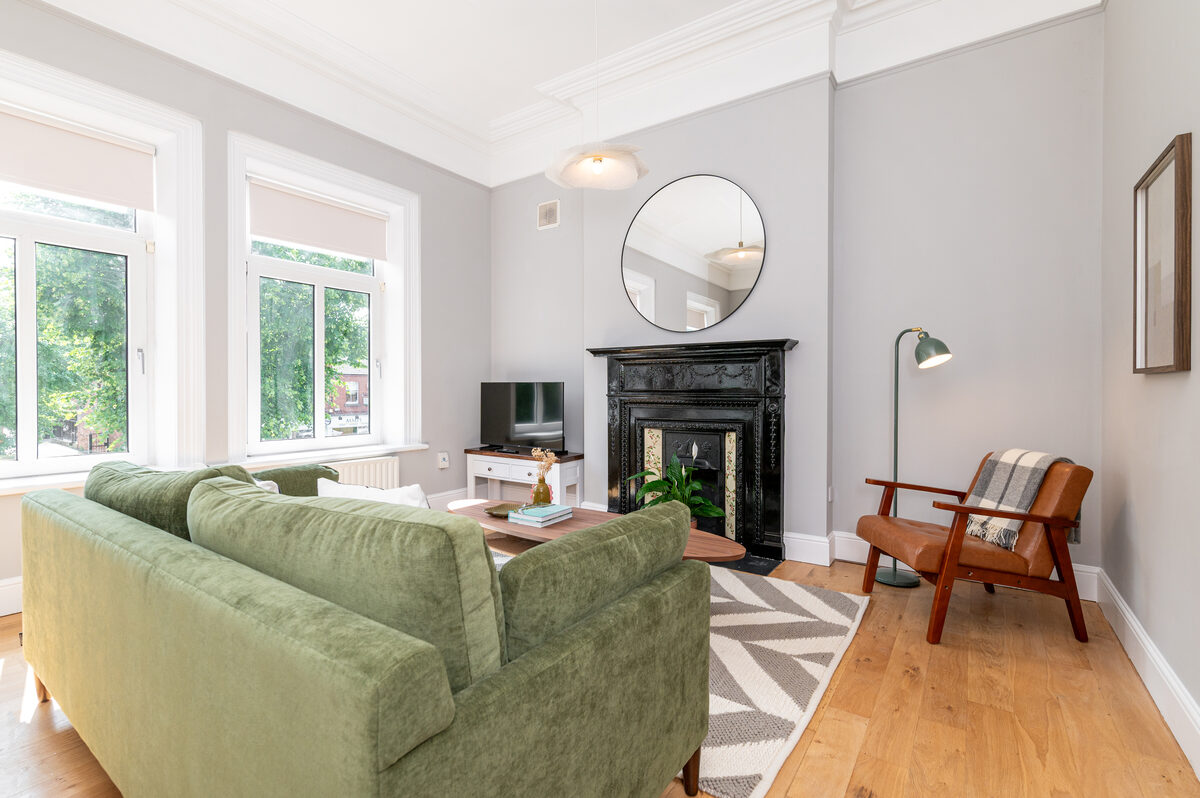
- Space to live and work. A separate living area, a desk, a full kitchen and a washer/dryer matter enormously when someone is in the city for weeks rather than nights. The guest can cook, host a quiet working dinner, do laundry, and keep something close to a normal routine.
- Wellbeing on long stays. The slow grind of hotel living — eating out every night, no kitchen, no sense of home — wears people down on extended assignments. A residential apartment in a real neighbourhood keeps performance up.
We make the full comparison, with numbers, in our piece on serviced apartments versus hotels in Dublin. The short version: under a week, book a hotel; over two weeks, book an apartment; in between, it depends on the guest.
Where to base your guest: a neighbourhood-by-neighbourhood read
This is the decision bookers get wrong most often, usually by defaulting to "city centre" because it sounds convenient. For a long corporate stay it frequently isn't — the central postcodes are noisier, the apartment stock is more commercial, and the guest sleeps worse. Here is how we actually match guests to neighbourhoods.
Donnybrook & Ballsbridge (Dublin 4) — the corporate default
If you only remember one recommendation, make it this one. Donnybrook and Ballsbridge are Dublin 4 — the embassy belt, home to the RDS and the Aviva Stadium, a short hop from the Grand Canal Dock tech cluster and fifteen minutes from the city centre. It is leafy, safe, walkable and genuinely residential, with restaurants and Herbert Park on the doorstep. This is the right call for senior executives, for guests hosting clients, and for relocating families scoping the city. It is our single most-requested area for corporate stays.
Ranelagh (Dublin 6) — village life, city access
Ranelagh sits two Luas Green Line stops from St Stephen's Green, with a compact, restaurant-rich village core and quiet period housing. It suits mid-stay guests (two weeks to three months) who want to feel like residents rather than visitors, and anyone commuting to the city centre or the southside business parks. We explain the full case in our Ranelagh corporate stays guide.
Dublin city centre (Dublin 1 & 2) — for proximity above all
If your guest needs to be on the doorstep of the IFSC, the legal quarter or a city-centre office at 7am every morning, the city centre apartments around Camden Street, Aungier Street and the quays are the right trade-off. You accept a slightly busier setting in exchange for a walk-to-work commute. Our Dublin 2 corporate guest guide goes deeper on this.
Islandbridge & Dublin 8 — calm by the river, value for money
Dublin 8, including our recently refreshed Islandbridge apartments, offers space and quiet on the banks of the Liffey beside Phoenix Park, with Heuston Station — and fast trains to Cork, Limerick and Galway — a short walk away. It suits guests who value calm and a slightly better rate over being in the thick of things. See the Dublin 8 corporate guest guide.
What to budget
Corporate serviced apartment pricing in Dublin is quoted weekly or monthly rather than per night, and the rate falls the longer the stay. As a planning guide, expect a well-located one- or two-bedroom serviced apartment in a prime southside postcode to sit meaningfully below the equivalent of a comparable hotel room booked for the same number of nights — and the gap widens sharply during high-demand weeks when hotels surge and apartment rates hold. Utilities, Wi-Fi, weekly housekeeping and linen are typically included in the rate, which removes the line-item surprises that make hotel-extras reconciliation painful. For a precise figure for specific dates, it is always quicker to request a quote than to guess.
Timing: when to book, and why early matters more here
Dublin has a genuine supply problem at the quality end of corporate accommodation, and it gets acute around predictable pressure points: the Dublin Horse Show in early August, Six Nations and autumn rugby internationals, the main conference season, and big stadium concerts at the Aviva and Croke Park. During those windows, both hotels and the good apartments fill weeks ahead and prices climb. If your guest's dates overlap any of them — and for any stay of two weeks or more, they very likely will — book as early as you possibly can. Our conference season accommodation guide maps out the specific dates worth planning around.
A short checklist before you book
- Confirm the real arrival and departure dates and add a buffer — flights move, projects extend.
- Match the neighbourhood to the guest, not to what sounds central. A senior exec and a 28-year-old consultant want different things.
- Check what's included — utilities, Wi-Fi speed, housekeeping frequency, workspace, parking — so there are no surprises on the expense claim.
- Confirm the point of contact. One of the biggest advantages of a good operator over a faceless platform is a direct line when something needs sorting at 9pm.
- Lock it in early for any dates near a major Dublin event.
How we make corporate booking straightforward
EirStay is built around exactly this audience. We house relocating executives, consultants, project teams and visiting professionals across sixteen apartments in Dublin 1, 2, 4, 6 and 8, all available for stays from fourteen nights with monthly and multi-month rates. Every booking comes with a single corporate point of contact, clean consolidated invoicing your finance team can actually reconcile, and a corporate agreement on file. For companies that book regularly, our corporate accommodation service sets up an account so repeat bookings take minutes rather than a fresh negotiation each time.
Booking for someone coming to Dublin? Browse the full range of corporate serviced apartments, see every available apartment, or tell us the dates and the brief and we'll come back the same day with options and a fixed quote. If you book corporate stays often, ask about a corporate account.